
Published by COMPUCHILD
A parent asks a simple question while teaching their child. Their child shrugs. The parent asks again, this time a little slower. Still no answer. By the third attempt, both parent and child are frustrated, and what started as a homework session has turned into tears, raised voices, or complete silence.
Many parents wonder why kids lose interest in learning, especially when they seem capable in other situations. The truth is that teaching is not just about explaining information. It is about helping a child experience an idea in a way that makes sense to them.
Reading together, practicing worksheets, and reviewing flashcards all have value. These approaches can strengthen knowledge and build important academic habits. But they also have limitations. When children only hear or read information, they may struggle to connect it to something meaningful. Sometimes it is not the child who needs a different approach. It is the learning experience itself.
Imagine a child struggling to understand angles in math. After several explanations, they still look confused. Then they begin building a simple shape with blocks, measuring each corner as they go. Suddenly, the lesson clicks. The concept has not changed. The experience has.
Here are five ways teaching can become easier and more effective by making learning more active.
1. Learning sticks better when children use their bodies and minds together
Arthur Glenberg’s research suggests that children understand and remember concepts more effectively when learning involves physical action rather than passive observation. His work on embodied cognition shows that movement helps the brain create stronger connections to new ideas.
Think about teaching directions. Reading “left” and “right” from a worksheet can be confusing. Walking through an obstacle course while following those directions often makes the concept much easier to remember.
This is one reason many hands-on educational programs encourage children to build, test, and experiment rather than simply watch demonstrations.
2. Children understand ideas more deeply when they discover them
Educational philosopher John Dewey believed children learn best through meaningful experiences rather than memorizing isolated facts. When children investigate problems and test solutions themselves, they develop understanding that lasts longer.
Imagine a child learning about plants. Reading about photosynthesis teaches vocabulary. Growing a plant, observing changes, and discussing why it grows gives those words real meaning.
This kind of discovery often plays an important role in well-crafted after-school enrichment programs, where students have the time to explore ideas beyond completing assignments.
3. Visuals and hands-on activities reduce mental overload
Richard Mayer’s research on multimedia learning shows that people learn more effectively when information is presented using both words and meaningful visuals. Well-designed learning activities help children organize information instead of becoming overwhelmed by it.
For example, fractions can seem abstract on paper. Cutting a pizza into equal slices or dividing a recipe into smaller portions allows children to see the math in everyday life.
When children can connect ideas to something they can touch or observe, learning often feels less frustrating.

Practicing fractions through everyday life experiences
4. Mistakes become valuable when children can immediately test new ideas
David Kolb’s theory of experiential learning explains that learning happens through a cycle of doing, reflecting, adjusting, and trying again. Instead of fearing mistakes, children use them as part of the learning process.
A child building a bridge from craft sticks quickly discovers that one design bends while another stays strong. Rather than simply being told the correct answer, they experience why one solution works better than another.
These moments often do more to develop confidence than getting every answer right on the first try.
5. Engagement grows when learning has a clear purpose
Educational psychologist Jerome Bruner emphasized that children learn more effectively when they actively solve problems instead of passively receiving information. Purpose creates curiosity, and curiosity keeps children engaged.
Imagine asking a child to memorize programming commands from a page. Compare that with asking them to build a simple game or make a robot complete a challenge. The same concepts become much more meaningful because they serve a real goal.
This approach is one reason project-based after-school education programs keep children motivated far longer than repetitive drills.
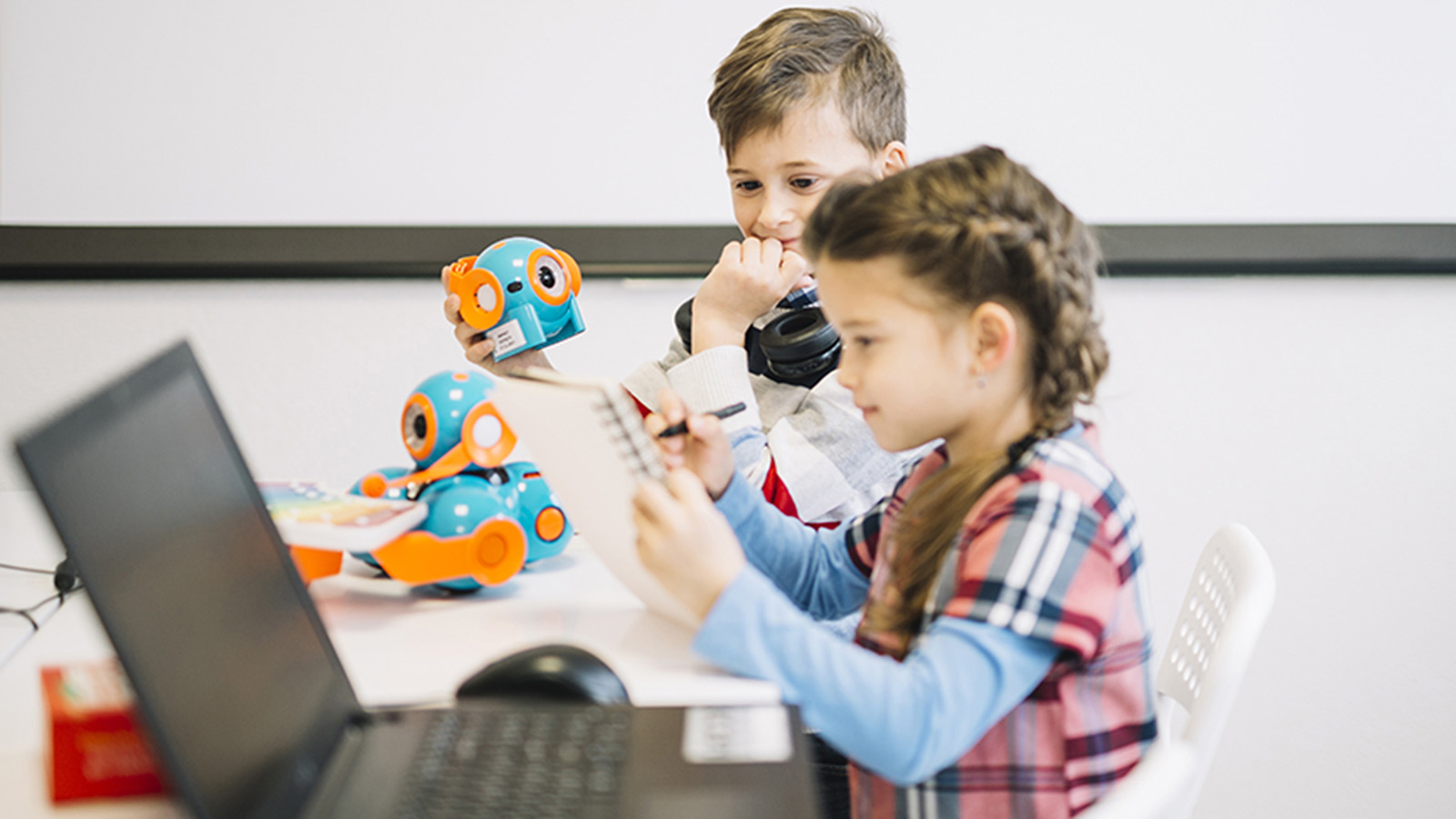
Real-world tasks with a purpose make learning more meaningful and tangible
CompuChild’s Experiences and Thoughts
Every child learns differently, but one principle appears again and again throughout educational research: children build a stronger understanding when they actively participate in learning rather than simply receiving information. The goal is not to replace reading or direct instruction. It is to give children opportunities to experience ideas in ways that make them meaningful.
At COMPUCHILD, we have seen this firsthand. As instructors, we have watched students work through hands-on STEAM and STEM projects that challenge them to think, test, and refine their ideas. During one of our camps, students learned the basics of programming through immersive drone flight simulations. The class carefully sequenced movements, tested flight paths, debugged their programs, and refined their solutions to complete increasingly complex challenges. Along the way, these elementary school students strengthened their logical reasoning skills and naturally explored geometry concepts related to shapes and angles. Experiences like these have shown us that children often become more engaged when they are actively creating, experimenting, and solving problems. At COMPUCHILD, we believe these hands-on experiences deepen understanding because students are not simply learning about concepts. They are applying them in meaningful ways. That belief continues to shape our approach to getting children excited about learning.
Children do not need every lesson to be entertaining, nor do they need every answer given to them. They need opportunities to think, explore, make mistakes, and discover solutions. Those experiences help build confidence, curiosity, and the habits of lifelong learners.
At COMPUCHILD, we believe meaningful education happens when children are invited to participate, not just observe. Whether through technology, creativity, or problem-solving, hands-on learning gives children opportunities to connect ideas with real experiences, making learning both more engaging and more memorable. While our mission is to foster entrepreneurial thinking through STEM, financial awareness, communication, and ethics, we place equal importance on how we teach. By creating hands-on, team-based, interactive learning experiences, we help children stay engaged, excited, and motivated to learn.
References
Dewey, John. Experience and Education. Kappa Delta Pi, 1938.
Glenberg, Arthur M. “What Memory Is For.” Behavioral and Brain Sciences, vol. 20, no. 1, 1997, pp. 1–55.
Kolb, David A. Experiential Learning: Experience as the Source of Learning and Development. 2nd ed., Pearson Education, 2015.
Mayer, Richard E. Multimedia Learning. 3rd ed. Cambridge: Cambridge University Press, 2020.
Bruner, Jerome S. The Process of Education. Rev. ed., Harvard University Press, 1977.
We recently explored this idea in a short video highlighting an important reality: teaching children is not always easy, especially when the teaching method does not align with the way a child learns best. Watch the video here.