
Published by COMPUCHILD
It is a scene many parents know well. Your child comes home from school, grabs a snack, and within minutes is scrolling through social media. One video turns into another, and before anyone notices, an hour or two has disappeared. If you have ever wondered whether your child is spending too much time on social media or why kids lose interest in learning after school, you are not alone.
Social media offers some real benefits. It helps children stay connected with friends, discover new interests, express themselves creatively, and even learn new skills. But when screen time begins replacing meaningful conversations, physical activity, creative play, or focused learning, it can quietly shape the way children think, learn, and interact with the world.
One mother recently shared that her ten-year-old son could explain the latest online trends in great detail but struggled to stay focused long enough to finish reading a short chapter book. She realized the issue was not that he lacked intelligence. His attention had simply become trained for constant novelty and instant rewards.
Here are five ways parents and educators can help children build a healthier relationship with social media while supporting their overall development.
1. Remember that children’s brains learn best through active experiences
Arthur Glenberg’s research suggests that children understand and remember ideas more deeply when learning involves real experiences rather than simply receiving information on a screen. In everyday life, this means children often learn more by building, experimenting, discussing, and creating than by endlessly watching content.
For example, rather than watching several videos about bridges, a child might remember much more by actually building one with simple materials and testing how much weight it can hold. Experiences like this spark curiosity while getting children excited about learning in meaningful ways.
2. Help children practice self-control instead of relying only on rules
Psychologist Walter Mischel’s famous Marshmallow Test demonstrated that children could develop self-regulation skills when given opportunities to practice delaying gratification. While later research has shown that many environmental factors also influence outcomes, the central idea remains valuable: self-control is a skill that grows with practice.
Instead of simply saying, “Put your phone away,” parents might encourage a child to complete homework, read for twenty minutes, or help prepare dinner before checking social media. Small routines like these gradually strengthen decision-making.
3. Balance digital entertainment with hands-on creativity
Educational researcher Seymour Papert believed children learn especially well when they actively create something meaningful. Rather than consuming endless content, children build confidence when they solve problems and make things themselves.
Imagine a child who spends an afternoon designing a simple game, building a robot, or creating a digital animation. Activities like these develop persistence, creativity, and problem-solving. They also introduce children to leading-edge digital technologies such as coding and artificial intelligence, turning technology into a tool for creation rather than passive entertainment.

Not just consuming tech, but creating with it
4. Protect attention because attention shapes learning
Developmental psychologist Adele Diamond’s work shows that executive function skills such as attention, working memory, and self-control are essential for learning success. Constant interruptions and rapid switching between short videos can make sustained focus more difficult for many children.
A simple family habit can make a noticeable difference. Setting aside one hour each evening with phones put away allows children to read, do puzzles, complete projects, or have conversations. This is where well-designed after-school enrichment programs can help, as they introduce children to innovative topics that spark lasting interests.
5. Replace excessive screen time with purposeful exploration
Psychologist Albert Bandura’s Social Learning Theory reminds us that children learn by observing the people around them. When adults demonstrate curiosity, creativity, and lifelong learning, children are more likely to develop those same habits.
For example, instead of spending Saturday afternoon on separate screens, a family might visit a science museum, work on a simple engineering challenge, or participate in weekend STEM and STEAM camps organized by a leading after-school education provider, COMPUCHILD. Experiences like these create memories and help children see learning as enjoyable rather than limited to school. These initiatives can help parents and homeschoolers excite their children about learning and education in natural, lasting ways.
CompuChild’s Experiences and Thoughts
When children spend less time passively consuming content and more time actively exploring, creating, and solving problems, they begin developing habits that serve them well long after childhood. The goal is not to eliminate social media but to create a healthier balance where technology supports learning instead of replacing it.
At COMPUCHILD, we have spent decades working with children from preschool through middle school, and we have seen a consistent pattern. Children are naturally curious. They want to ask questions, build things, solve problems, and understand how the world works. We have also observed that when children participate in engaging, hands-on learning experiences, their confidence often grows alongside their curiosity. Our experience continues to reinforce our belief that children thrive when they are encouraged to become active participants in their own learning rather than passive consumers of information.
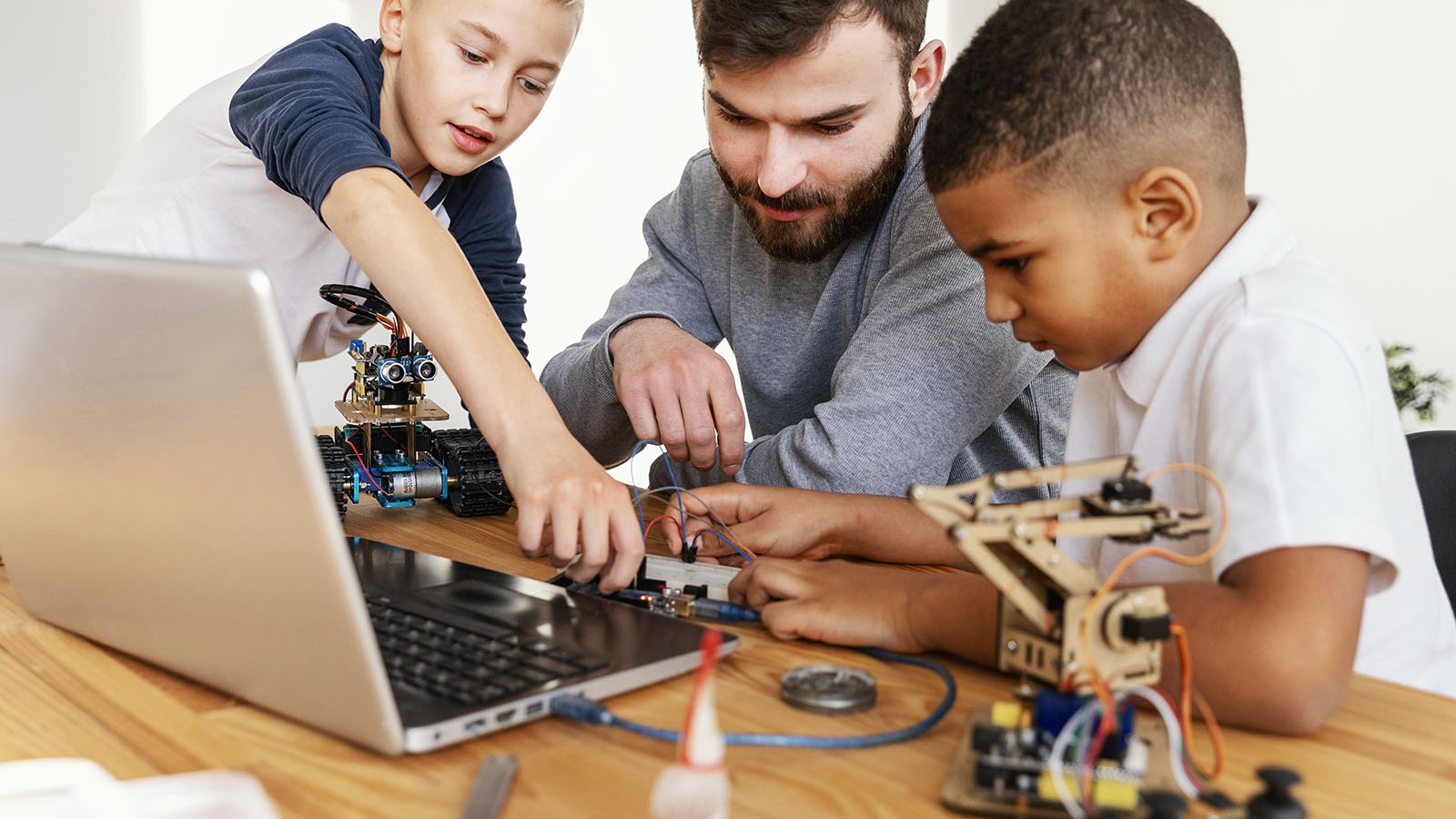
Hands-on learning experiences for children
As educators, we believe childhood should be filled with opportunities to explore, question, imagine, and create. Social media will continue to be part of children’s lives, but it should never become the primary way they experience the world. The strongest foundation for lifelong learning comes from meaningful relationships, real-world experiences, thoughtful guidance, and the chance to discover new passions. When children engage with ideas through curiosity and action, they develop not only knowledge but also resilience, confidence, and a genuine love of learning that lasts a lifetime. COMPUCHILD’s after-school programs are designed to give children real opportunities to explore, question, imagine, and create.
References
- Bandura, Albert. Social Learning Theory. Prentice Hall, 1977.
- Diamond, Adele. “Executive Functions.” Annual Review of Psychology, vol. 64, 2013, pp. 135–168.
- Glenberg, Arthur M. “What Memory Is For.” Behavioral and Brain Sciences, vol. 20, no. 1, 1997, pp. 1–55.
- Mischel, Walter, Yuichi Shoda, and Monica L. Rodriguez. “Delay of Gratification in Children.” Science, vol. 244, no. 4907, 1989, pp. 933–938.
- Papert, Seymour. Mindstorms: Children, Computers, and Powerful Ideas. Basic Books, 1980.
We recently explored this idea in a short video. With kids spending hours on social media, should parents let it happen, set limits, or use it as a tool? Watch the video here.